
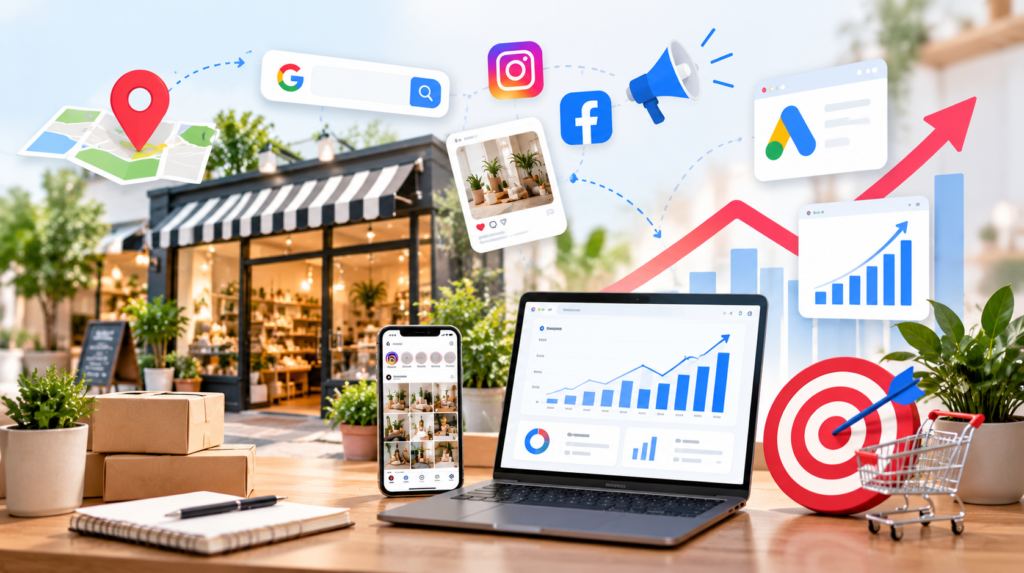
Small businesses need more than a good product or service to succeed. They also need to reach the right audience, build trust, and give potential customers a reason to choose them. In an increasingly digital world, having a strong online presence can help businesses connect with customers and create new growth opportunities.
This is where digital marketing strategies for small businesses become important. From improving search engine visibility to promoting services on social media, digital marketing provides several ways to reach people who may be interested in what your business offers.
However, using every marketing channel is not necessary. The key is to understand your audience, choose suitable platforms, and focus on activities that support your business goals.
In this guide, we explore practical digital marketing strategies that small businesses can use to strengthen their online presence, attract potential customers, and improve marketing performance.
What Is Digital Marketing for Small Businesses?
Digital marketing involves promoting products or services through online channels such as search engines, websites, social media, email, and paid advertising platforms.
For small businesses, online marketing can help communicate their offerings, reach relevant audiences, generate enquiries, and maintain relationships with existing customers.
For example, a local clothing store can use social media marketing to showcase new collections, optimize its Google Business Profile so customers can find its location, and run paid advertising campaigns to promote seasonal offers.
Similarly, a professional service provider can use a business website, search engine optimization (SEO), and Google Ads to connect with people actively searching for its services.
The right approach depends on the business’s industry, target audience, budget, and objectives.
Why Do Small Businesses Need a Digital Marketing Strategy?
Simply creating social media accounts or launching advertisements does not guarantee meaningful results. A clear digital marketing strategy helps businesses decide what to do, why it matters, and how to measure progress.
1. Improve Online Visibility
Potential customers often search online before choosing a business. A well-maintained website, relevant content, and an optimized Google Business Profile can make it easier for people to discover your business.
2. Reach the Right Audience
Different digital channels serve different purposes. Search engines help connect businesses with people looking for specific information or services, while social media can help introduce a brand to relevant audiences.
3. Generate Leads and Enquiries
Digital marketing can direct interested customers to a website, contact form, phone number, or WhatsApp conversation. Clear calls to action make it easier for potential customers to take the next step.
4. Measure Marketing Performance
Analytics tools and advertising reports help businesses understand website traffic, campaign engagement, enquiries, and conversions. This information can guide future marketing decisions.
7 Digital Marketing Strategies for Small Businesses
1. Build a Professional Business Website
Your website is often an important part of your digital presence. It provides a place where potential customers can learn about your business, understand your offerings, and contact you.
A well-planned website should include:
Clear information about your business and services.
Easy navigation and a logical page structure.
Responsive web design that works across devices.
Relevant service or product information.
Contact details and enquiry forms.
Clear calls to action, such as “Request a Quote” or “Contact Us.”
Example: An interior design business can create dedicated pages for residential and commercial services, display its completed projects, and include a consultation enquiry form.
Investing in suitable website design for a small business can help establish credibility and provide a central destination for other marketing activities. Website content should also be organized around what potential customers want to know.
2. Invest in Search Engine Optimization (SEO)
Search engine optimization helps improve a website’s visibility in organic search results. It allows businesses to reach people searching for products, services, and information relevant to their needs.
A practical SEO strategy includes:
Keyword research: Identify the search terms your audience uses.
On-page SEO: Improve page titles, headings, content, and internal links.
Technical SEO: Address relevant crawling, indexing, and website performance issues.
Content optimization: Create useful pages and articles that answer customer questions.
Local SEO: Improve visibility for relevant location-based searches.
Performance monitoring: Review search impressions, clicks, and landing-page performance.
For example, a business serving Belagavi might create a useful service page targeting relevant searches such as “interior designer in Belagavi,” provided the phrase accurately describes its service and location.
SEO for small businesses requires consistency and realistic expectations. Rankings depend on competition, relevance, website quality, and other factors, so results cannot be guaranteed within a fixed timeframe.
3. Strengthen Your Social Media Marketing Strategy
Social media marketing helps businesses communicate with their audiences, showcase their offerings, and maintain a recognizable brand presence.
Rather than creating accounts on every platform, choose the channels that make sense for your customers and business model.
A practical social media marketing strategy should include:
A clear understanding of your target audience.
Consistent brand messaging and visual identity.
A manageable content calendar.
Educational and informative posts.
Product or service highlights.
Relevant promotional campaigns.
Audience engagement and performance tracking.
Example: A restaurant could share menu highlights, food photography, customer updates, and seasonal offers. A B2B service company might publish industry insights, explain common customer challenges, and share useful educational content.
The goal is not simply to publish frequently. It is to create relevant content that helps your audience understand your business and encourages meaningful engagement.
4. Optimize Your Google Business Profile
For businesses serving a particular city or area, Google Business Profile optimization is an important part of local digital marketing.
A complete and accurate profile can help customers discover your business through Google Search and Google Maps.
To improve your profile:
Ensure your business name, category, address or service area, and opening hours are accurate.
Add appropriate photos of your business, products, premises, or work.
Keep contact information and website links updated.
Respond professionally to genuine customer reviews.
Publish relevant updates where appropriate.
Monitor available profile performance information.
For example, a local clinic can use its profile to provide accurate opening hours, contact details, directions, and information about its services.
Google identifies relevance, distance, and prominence as factors in local search results. Profile optimization can support discoverability, but it does not guarantee a particular ranking.
5. Use Google Ads and Meta Ads Strategically
Paid advertising can help small businesses reach relevant audiences and promote specific offers, products, or services.
Two widely used options are Google Ads and Meta Ads.
Google Ads can help businesses reach people searching for relevant services. For instance, a person searching for website development services may already be considering hiring a provider.
Meta Ads can help businesses promote products, build awareness, and generate enquiries through advertising on platforms such as Facebook and Instagram.
Before launching an advertising campaign:
Define the campaign objective.
Identify the intended audience.
Choose relevant keywords or audience targeting options.
Prepare suitable ad copy and creative assets.
Set an affordable budget.
Direct users to a relevant landing page or enquiry channel.
Track conversions and review campaign performance.
For businesses that rely on paid advertising, monitoring cost per lead, qualified enquiries, and conversions is more useful than evaluating performance only through clicks or impressions.
Start with a manageable budget and use campaign data to identify opportunities for improvement. Advertising performance depends on the offer, audience, competition, campaign setup, and follow-up process.
6. Create Useful Content Through Blogging
Content marketing helps businesses answer customer questions, explain their expertise, and provide information that supports purchasing decisions.
Blog articles, guides, FAQs, videos, and educational social media posts can all contribute to a content strategy.
For example, a website development company could publish an article explaining website development costs in India. A digital marketing agency could write about SEO, Google Ads, local SEO, or social media marketing for small businesses.
To create useful blog content:
Research relevant keywords and search intent.
Choose topics connected to your audience’s needs.
Use clear headings and concise paragraphs.
Include practical examples and actionable advice.
Link to related service pages where relevant.
Add a suitable call to action.
Blogging should prioritize helpful information rather than repeating keywords excessively. A well-planned content strategy can support organic visibility and help readers discover your services naturally.
7. Track Results and Improve Your Marketing
An effective digital marketing strategy includes regular performance reviews. Tracking the right metrics helps businesses understand which activities contribute to their objectives.
| Goal | Metrics to monitor |
|---|---|
| Improve SEO visibility | Search impressions, clicks, organic traffic |
| Build social media awareness | Reach, engagement, profile visits |
| Generate leads | Qualified enquiries, conversion rate |
| Evaluate paid advertising | Cost per lead, conversions, cost per conversion |
| Improve website performance | Landing-page activity, form submissions, conversion paths |
| Measure local discovery | Relevant profile interactions, calls, direction requests |
Tools such as Google Analytics, Google Search Console, Google Ads reporting, and Meta Ads Manager can help monitor different aspects of marketing performance.
Ensure that conversion tracking is configured correctly before using the numbers to make decisions. Review performance regularly, identify areas that need improvement, and adjust your marketing activities accordingly.
How to Create a Digital Marketing Plan on a Limited Budget
Small businesses do not always have the resources to manage multiple channels at once. A focused plan can help prioritize the activities most relevant to business goals.
Step 1: Set Clear Goals
Decide what you want your marketing to achieve. Your priorities might include increasing enquiries, improving local visibility, generating website traffic, or promoting a new service.
Step 2: Understand Your Customers
Identify your audience, their needs, their location, and how they search for solutions. This will help you choose relevant platforms and create more useful messaging.
Step 3: Establish Your Online Presence
Ensure that your website, social media profiles, and business listings contain accurate information. Make it easy for customers to understand your offerings and contact you.
Step 4: Choose Your Priority Channels
If people actively search for your services, SEO and Google Ads may be worth considering. If your products are highly visual, social media marketing may be useful. Local businesses should also assess the value of local SEO and Google Business Profile management.
Step 5: Review and Improve
Set a regular time to review results. Compare performance with your goals, identify what needs attention, and allocate resources based on evidence rather than assumptions.
There is no single digital marketing budget that works for every business. Start with what you can manage, establish a clear plan, and expand your activities as your needs and resources change.
Common Digital Marketing Mistakes to Avoid
Even useful marketing channels can underperform when they are not supported by a clear strategy.
Trying to do everything at once: Focus on the channels most relevant to your audience instead of spreading your resources too thinly.
Running advertisements without a clear objective: Decide whether you want awareness, enquiries, bookings, or sales before launching campaigns.
Ignoring website usability: Confusing navigation, unclear service information, or difficult enquiry forms can discourage potential customers.
Publishing content without a plan: Content should address customer needs and support business objectives rather than exist only to fill a calendar.
Focusing only on vanity metrics: Followers and impressions may be useful indicators, but they do not automatically translate into leads or sales.
Expecting immediate SEO results: Organic visibility usually requires ongoing work, and results vary by business and competition.
Failing to follow up on enquiries: Timely, helpful communication is important for turning marketing-generated enquiries into customer relationships.
Frequently Asked Questions
What are the best digital marketing strategies for small businesses?
The most suitable strategies depend on your audience, industry, budget, and goals. Many businesses start with a professional website, SEO, social media marketing, and an accurate Google Business Profile. Paid advertising may be useful when there is a clear objective and a plan to measure performance.
How much does digital marketing cost for a small business?
Costs depend on the services required, campaign scope, competition, advertising spend, and whether activities are managed internally or by an agency. Website development, SEO, social media management, and paid advertising have different cost structures. Request a clear breakdown of service fees and advertising budgets before committing.
Is digital marketing suitable for local businesses?
Yes. Local businesses can use local SEO, Google Business Profile management, location-relevant website content, social media, and targeted advertising to help potential customers discover their offerings.
How long does digital marketing take to show results?
Timelines vary by channel and objective. Paid advertising can start generating traffic soon after launch, but meaningful and profitable results are not guaranteed. SEO generally requires sustained effort before improvements become visible. Performance should be evaluated over an appropriate period using relevant metrics.
Should a small business hire a digital marketing agency?
A business may benefit from an agency when it needs specialist expertise, a structured marketing plan, campaign management, website support, or performance reporting. The decision depends on available resources, internal capabilities, and business priorities.
How can I measure digital marketing success?
Begin by defining the outcomes that matter to your business. Track relevant measures such as qualified enquiries, sales, conversion rates, cost per lead, and return on ad spend where applicable. Use analytics and advertising reports to understand performance and identify improvements.
Conclusion
Digital marketing can give small businesses several ways to build visibility, connect with potential customers, and create new opportunities. However, success does not come from using every platform or spending as much as possible.
It comes from understanding your audience, choosing the right channels, creating useful content, maintaining a reliable online presence, and measuring the outcomes that matter.
Start with a clear plan, focus on the activities most relevant to your business, and improve your strategy as you learn from the results.
Ready to Strengthen Your Online Presence?
The Digistry helps businesses explore digital marketing solutions, including website design and development, SEO, social media marketing, Google Business Profile management, and paid advertising.
Let’s discuss your business goals and find the right digital marketing approach for your needs.
[Explore Our Services] | [Contact The Digistry]
