
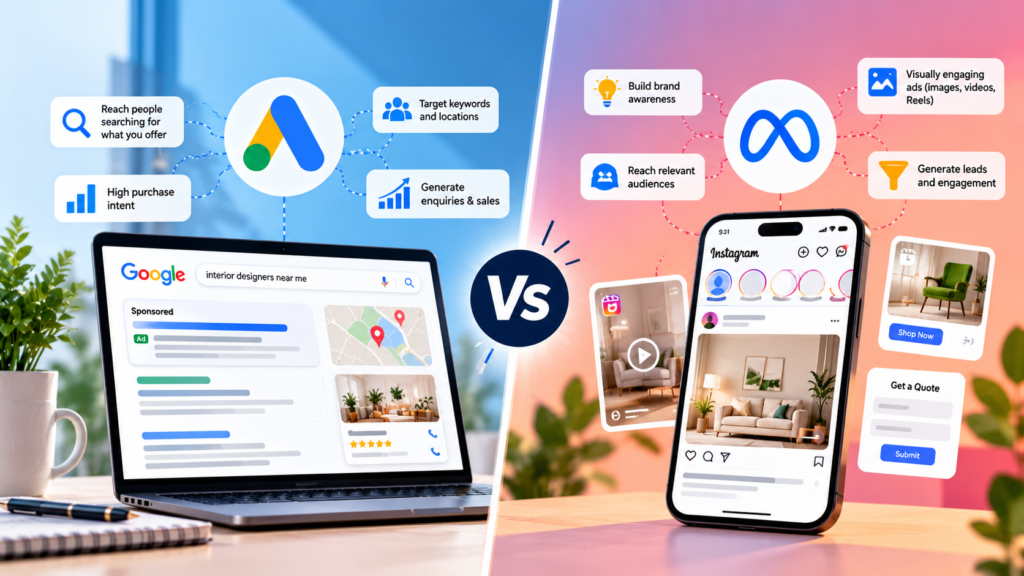
If you want to grow your business online, paid advertising can help you reach potential customers, generate enquiries, and increase sales. However, one common question businesses face is: Should you invest in Google Ads or Meta Ads?
Both platforms offer powerful advertising opportunities, but they work differently. Google Ads helps businesses connect with people searching for specific products or services, while Meta Ads allows businesses to reach audiences through platforms such as Facebook and Instagram.
Choosing the right platform depends on your business goals, target audience, budget, and how customers discover your products or services.
In this guide, we compare Google Ads vs Meta Ads, explore their key differences, and explain how to decide which platform is suitable for your business.
What Are Google Ads?
Google Ads is Google’s online advertising platform that allows businesses to promote their products and services across Google’s advertising network.
One of its most widely used formats is Search advertising, where ads can appear when people search for relevant keywords on Google.
For example, someone searching for “digital marketing agency in Belgaum” may see relevant sponsored results from businesses offering those services.
Depending on the campaign type, Google Ads can also reach audiences through YouTube, websites and apps in Google’s advertising network, Google Maps placements, and other eligible surfaces.
Benefits of Google Ads
Reach customers with clear intent: Connect with people actively searching for products or services like yours.
Target relevant searches: Use keywords, locations, and other campaign settings to reach suitable audiences.
Generate enquiries: Encourage potential customers to call, fill out forms, book appointments, or visit your website.
Measure performance: Track metrics such as clicks, conversions, cost per lead, and return on ad spend when tracking is configured correctly.
Control your budget: Set campaign budgets and adjust spending based on performance.
When Should You Use Google Ads?
Google Ads can be a good option when customers already search for what your business offers.
It may be suitable for:
Service-based businesses, such as digital marketing agencies and consultants.
Healthcare providers and educational institutions.
Real estate businesses targeting property-related searches.
Local businesses offering repair, maintenance, or professional services.
Businesses selling products that customers actively search for.
For example, a person searching for “website development company in Belgaum” may already be considering hiring a service provider. A relevant Google Search ad can help your business appear during that decision-making process.
What Are Meta Ads?
Meta Ads is the advertising platform used to run paid campaigns across Facebook, Instagram, Messenger, and other eligible Meta placements.
Unlike search advertising, Meta Ads can introduce your business to people who may not be actively looking for your products or services.
For example, a local gym can run Instagram Reels ads showcasing its facilities, trainers, and membership offers to reach people in its service area.
Meta Ads supports different campaign objectives, including awareness, traffic, engagement, leads, and sales.
Benefits of Meta Ads
Build brand awareness: Introduce your business to people who may not know about it yet.
Use visual storytelling: Promote your offerings through images, videos, Reels, and other creative formats.
Reach relevant audiences: Use available audience settings, customer data, and engagement signals to guide ad delivery.
Generate leads: Encourage users to submit enquiry forms, contact your business, or start conversations through supported messaging options.
Retarget interested audiences: Reach eligible people who have previously interacted with your business or website, subject to platform requirements and privacy settings.
When Should You Use Meta Ads?
Meta Ads can be useful when your business needs to build awareness, demonstrate an offering, or generate interest among a defined audience.
It may be suitable for:
Fashion, beauty, lifestyle, and home decor brands.
Gyms, restaurants, salons, and other local businesses.
Real estate projects and property launches.
Educational institutions promoting courses or admissions.
Businesses launching a new product, service, or offer.
For example, a clothing store can use Instagram ads to showcase a new collection through attractive visuals and direct interested users to its website or store.
Google Ads vs Meta Ads: Key Differences
Although both platforms support paid advertising, their strengths and advertising approaches differ.
| Feature | Google Ads | Meta Ads |
|---|---|---|
| Primary approach | Connects with people searching for relevant solutions | Introduces offers to relevant audiences while they browse |
| Main platforms | Google Search, YouTube, and other eligible Google advertising placements | Facebook, Instagram, and other eligible Meta placements |
| Targeting | Search keywords, locations, audiences, and campaign settings | Audience characteristics, interests where available, customer data, and engagement signals |
| Common ad formats | Search text ads, video ads, display ads, and other campaign formats | Image ads, video ads, Reels, Stories, carousels, and lead ads |
| Common use cases | Capturing existing search demand and enquiries | Building awareness, creating interest, and generating leads |
| Creative requirements | Relevant keywords, clear messaging, and useful landing pages | Engaging visuals, compelling messaging, and strong creative |
| Performance measurement | Clicks, conversions, cost per lead, and revenue where tracked | Reach, engagement, leads, conversions, and revenue where tracked |
Neither platform is automatically better for every business. The right choice depends on customer behaviour, campaign objectives, competition, and the quality of your advertising strategy.
Which Platform Is More Cost-Effective?
Advertising cost is an important consideration when deciding between Google Ads and Meta Ads. However, there is no fixed rule that one platform is always cheaper.
Your costs can vary depending on your industry, location, audience, competition, campaign settings, ad quality, and the offer you promote.
Google Search campaigns may involve higher costs for competitive keywords, but they can connect you with people actively looking for a solution.
Meta campaigns may generate relatively inexpensive clicks or reach in some situations, but those visitors may need more information and follow-up before becoming customers.
Instead of comparing only cost per click, measure:
Cost per lead: How much you spend to generate an enquiry.
Cost per qualified lead: How much you spend to attract a prospect who fits your requirements.
Conversion rate: The percentage of visitors or leads who complete the desired action.
Customer acquisition cost: How much it costs to acquire a paying customer.
Return on ad spend (ROAS): The revenue attributed to advertising relative to ad spend, where revenue tracking is available.
For example, a campaign generating fewer enquiries may still be more valuable if those enquiries are more likely to become paying customers.
The objective is not simply to get more clicks. It is to generate meaningful business results within a sustainable budget.
Google Ads vs Meta Ads: Which Is Better for Lead Generation?
Both platforms can generate leads, but they approach lead generation differently.
Google Ads can capture demand when potential customers search for a service, compare providers, or look for a solution to a specific problem.
Meta Ads can create interest among relevant audiences through engaging content, special offers, testimonials, videos, and lead-generation campaigns.
Consider a digital marketing agency as an example.
A Google Ads campaign can target searches related to digital marketing services in a particular city. A Meta Ads campaign can showcase the agency’s work, explain its services, or promote a consultation to business owners.
Both approaches can generate enquiries, but the quality and cost of those enquiries will depend on the campaign and follow-up process.
To improve lead generation on either platform:
Define your target audience and campaign objective.
Create a clear, relevant offer.
Direct visitors to a suitable landing page or enquiry form.
Set up conversion tracking correctly.
Respond to enquiries promptly.
Evaluate lead quality and actual sales, not just the number of form submissions.
Can You Run Google Ads and Meta Ads Together?
Yes. In many situations, using both platforms can support a more complete digital advertising strategy.
Google Ads and Meta Ads can serve different purposes at different stages of the customer journey.
For example, a real estate company could use Meta Ads to introduce a new residential project through videos, property images, and location-focused campaigns. Google Ads could then reach people searching for apartments or residential projects in that area.
A business may also use Meta Ads to reconnect with eligible website visitors while using Google Ads to capture relevant searches.
When running both platforms, make sure each campaign has a clear role. Avoid splitting a limited budget across too many campaigns before you have enough data to evaluate their performance.
How to Combine Both Platforms
Use Meta Ads to introduce your business and build awareness among relevant audiences.
Use Google Search ads to reach people actively searching for your products or services.
Use remarketing where appropriate to reconnect with interested visitors.
Track leads, sales, and revenue across your campaigns as accurately as possible.
Compare the overall results rather than judging each platform in isolation.
Your budget allocation should depend on your goals, available search demand, audience behaviour, and campaign performance. There is no universal budget split that works for every business.
How to Choose the Right Advertising Platform for Your Business
Before investing in paid advertising, answer these five questions.
1. What Is Your Main Goal?
If your primary objective is to capture enquiries from people already searching for your service, Google Search Ads may be a useful starting point.
If you want to introduce a new product, increase awareness, or showcase your offering visually, Meta Ads may be worth testing.
2. How Do Customers Discover Your Business?
Consider whether customers search for your service on Google or discover businesses through social media.
For example, people may actively search for a nearby dentist, while a new fashion collection may attract attention through Instagram content.
3. What Is Your Advertising Budget?
Start with a budget your business can afford to test and evaluate. Consider your industry’s competition, the likely cost of reaching your audience, and the number of conversions you need to make a useful decision.
Avoid choosing a platform based only on low advertised or estimated click costs.
4. Do You Have a Website or Landing Page?
A well-structured landing page can help visitors understand your offer and take action.
Before launching campaigns, check that your website loads properly, displays well on mobile devices, includes clear calls to action, and has working enquiry forms or contact options.
5. How Will You Measure Success?
Define the results you want before launching a campaign. Depending on your objective, these might include qualified leads, appointments, purchases, or revenue.
Set up suitable conversion tracking and review the quality of the results regularly.
Final Verdict: Google Ads or Meta Ads?
There is no single winner in the Google Ads vs Meta Ads comparison. Each platform can contribute to business growth when used for the right purpose.
Choose Google Ads when your customers are actively searching for the products or services you offer and relevant search demand exists.
Consider Meta Ads when your business benefits from visual promotion, audience discovery, brand awareness, or engaging content that encourages people to take action.
If your budget, resources, and tracking setup allow it, you can test both platforms and allocate spending according to measurable results.
The most effective advertising strategy starts with understanding your audience, choosing a clear objective, creating relevant campaigns, and continually improving performance.
Grow Your Business with The Digistry
At The Digistry, we help businesses strengthen their online presence through Google Ads, Meta Ads, social media marketing, SEO, and website design and development.
Whether your goal is to generate qualified leads, increase brand awareness, or attract more customers, our team can help you develop a digital marketing strategy aligned with your business objectives.
Ready to make your advertising work harder for your business? Contact The Digistry to discuss your digital marketing goals.
Frequently Asked Questions (FAQs)
1. Is Google Ads better than Meta Ads?
Not in every situation. Google Ads can be effective for reaching people actively searching for a solution, while Meta Ads can be effective for building awareness and generating interest among relevant audiences. Your business goals and customer behaviour should guide your choice.
2. Which is cheaper, Google Ads or Meta Ads?
Costs vary by industry, audience, competition, campaign type, and conversion performance. Compare cost per qualified lead, customer acquisition cost, and revenue rather than relying only on cost per click.
3. Can small businesses use Google Ads and Meta Ads?
Yes. Small businesses can use either platform, provided they set realistic budgets, choose appropriate audiences, create relevant ads, and monitor results. Starting with one clearly defined campaign can make performance easier to evaluate.
4. Can Google Ads and Meta Ads generate leads?
Yes. Google Ads can capture enquiries from people searching for relevant services, while Meta Ads can generate leads through campaigns designed to encourage forms, messages, or other actions. Lead quality depends on targeting, the offer, and the follow-up process.
5. Should I run Google Ads and Meta Ads at the same time?
You can run both when each platform has a clear purpose and your budget supports meaningful testing. Use reliable conversion tracking and compare the quality and business value of the results before increasing spending.
